

He has been the CFO or controller of both small and medium sized companies and has run small businesses of his own. He has been a manager and an auditor with Deloitte, a big 4 accountancy firm, and holds a degree from Loughborough University. The number of closing activities may be quite substantially longer than the list shown here, depending upon the complexity of a company’s operations and the number of subsidiaries whose results must be consolidated. For the past 52 years, Harold Averkamp (CPA, MBA) hasworked as an accounting supervisor, manager, consultant, university instructor, and innovator in teaching accounting online. He is the sole author of all the materials on AccountingCoach.com.

Closing Entries: Definition, Types, and Examples
In a sole proprietorship, a drawing account is maintained to record all withdrawals made by closing entries the owner. In a partnership, a drawing account is maintained for each partner. All drawing accounts are closed to the respective capital accounts at the end of the accounting period. In this example we will close Paul’s Guitar Shop, Inc.’s temporary accounts using the income summary account method from his financial statements in the previous example. Permanent accounts track activities that extend beyond the current accounting period.
Permanent versus Temporary Accounts

This is the same figure found on the statement ofretained earnings. To close expenses, we simply credit the expense accounts and debit Income Summary. Now, it’s time to close the income summary to the retained earnings (since we’re dealing with a company, not a small business or sole proprietorship). https://www.facebook.com/BooksTimeInc/ In order to produce more timely information some businesses issue financial statements for periods shorter than a full fiscal or calendar year. Such periods are referred to as interim periods and the accounts produced as interim financial statements. If your business is a corporation, you will not have a drawing account, but if you paid stockholders, you will have a dividends account.
Step 3: Close and Credit
- An individual might define their net income as the portion of their paycheck they can spend on discretionary expenses after taxes have been withheld and they’re reserved an adequate portion to meet their monthly budget.
- We could do this, but by having the Income Summaryaccount, you get a balance for net income a second time.
- This process highlights a company’s financial performance and position.
- The balance in Income Summary is the same figure as whatis reported on Printing Plus’s Income Statement.
- Notice that the balance of the Income Summary account is actually the net income for the period.
- In short, we can clear all temporary accounts to retained earnings with a single closing entry.
This trial balance gives the opening balances for the next accounting period, and contains only balance sheet accounts including the new balance on the retained earnings account as shown below. If a temporary account has a debit balance it is credited to bring it to zero, and the retained earnings account is credited to balance the closing entry. Likewise, if a temporary account has a credit balance, it is debited to bring it to zero and the retained earnings account is credited. The closing entries are dated in the journal as of the last day of the accounting period.
- This means thatit is not an asset, liability, stockholders’ equity, revenue, orexpense account.
- The closing entries are dated in the journal as of the last day of the accounting period.
- To close the drawing account to the capital account, we credit the drawing account and debit the capital account.
- On the balance sheet, $75 of cash held today is still valued at $75 next year, even if it is not spent.
- The first entrycloses revenue accounts to the Income Summary account.
- This crucial step ensures that financial records are accurate and up-to-date for the next period, making it easier to track the company’s performance over time.
How to Prepare Your Closing Entries
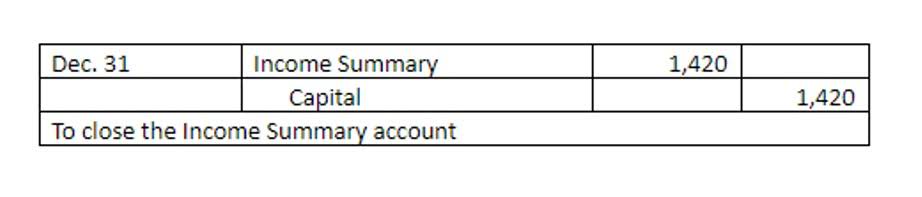
It can be a calendar year for one business while another business might use a fiscal quarter. The $10,000 of revenue generated through the accounting period will be shifted to the income summary account. Whether you’re processing closing entries manually, or letting your accounting software do the work, closing entries are perhaps the most important part of the accounting cycle. Corporations will close the income summary account to the retained earnings account. Closing entries are completed at the end of each accounting period after your adjusted trial balance has been run. One of https://www.bookstime.com/articles/post-closing-trial-balance the most important steps in the accounting cycle is creating and posting your closing entries.

Instead, the basic closing step is to access an option in the software to close the reporting period. Doing so automatically populates the retained earnings account for you, and prevents any further transactions from being recorded in the system for the period that has been closed. The second entry requires expense accounts close to the IncomeSummary account. To further clarify this concept, balances are closed to assureall revenues and expenses are recorded in the proper period andthen start over the following period. Closing journal entries are made at the end of an accounting period to prepare the accounting records for the next period. They zero-out the balances of temporary accounts during the current period to come up with fresh slates for the transactions in the next period.